

What is the appropriate amount of dissolved oxygen?
Dissolved oxygen is a very important component of a healthy water system or watercourse. It is therefore very important to ensure that DO levels are optimal. The amount of dissolved oxygen in water can vary from 0 to 18 ppm (parts per million). Local authorities, environmental agencies, and utility companies are required to measure DO levels regularly. Operators of fishing ponds and fish farms also have an interest in maintaining a healthy balance of dissolved oxygen. How does oxygen get into the water?
Oxygen can enter a water system in several ways, but these are generally classified as surface and subsurface aeration. Oxygen from the atmosphere can dissolve and mix at the water's surface. Examples of atmospheric surface aeration include wind disturbing the water surface and the movement of streams, waterfalls, or similar water flows. Algae and other underwater plants produce oxygen during photosynthesis and release it into the water. Oxygen is used by fish, as well as important aerobic bacteria that can break down excess nutrients in the water.

Implemented and tested solution in a real project
Dissolved oxygen (DO) is one of the most important indicators of water quality. IoT (Internet of Things) dissolved oxygen sensors are used to accurately measure the amount of oxygen in water and transmit the results in real time to a central database, cloud, or water monitoring platform. Dissolved oxygen refers to the amount of free oxygen in a body of water; oxygen is vital for the survival of fish and other aquatic life. The ability to automatically and accurately measure DO in a body of water using IoT equipment has many advantages over traditional methods.
Project scope:
- Seven fish farms located in different parts of Lithuania participated in the project
- 60 x aquamod units with dissolved oxygen sensors were used
- A separate cloud user was created for each aquaculture farm, with the ability to analyze the sensors and emergency notifications assigned to their farm
Used hardware and solutiom
AQUAMOD LoraWAN node
- The AquaMod module is easy to install because it is pre-configured at the factory, so it starts working right away.
- Additional configuration and diagnostics on site via WiFi and web interface
- AquaMod autonomous operation (2 to 5 years of operation from a lithium battery). Operating time depends on sensor type, distances, and measurement frequency.

Various digital sensors can be connected:
- Temperature Oxygen, pH,
- Conductivity, Salinity, Redox
- Turbidity and SS, sludge level
- SAC, BOD, TOC, etc.
IoT Cloud platform and data analysis

IoT Cloud provides vertical integration with LoRaWAN sensors and controllers. It visualizes field data and allows the user to monitor and control remotely on an intuitive device dashboard.
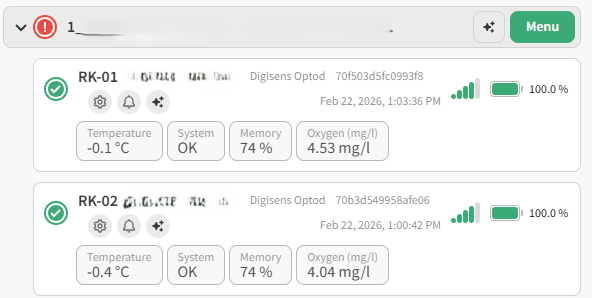

- Real-time monitoring and data transmission from digital sensors (alarm when a limit is exceeded, low battery, sensor defect, etc.)
- Private LoRaWAN communication network, no need to pay the operator
- Intuitive user interface: computer, smartphone, tablet
Do you have a similar problem?
Our team is ready to take care of the entire solution from start to stable operation
-
We will select the most suitable sensors for your process
- We will design, install, and perform commissioning and adjustment
- We will ensure maintenance and reliable system operation
You will receive real-time data and a functioning system — without any additional worries.
Related product

